
After the Storm

After the Storm | An Essay | Indigo Sawyer
There was nothing typical about Memorial Day weekend 2019 in Dayton. Some families, prepared to honor deceased loved ones who’d once served in the military, considered instead whether to attend a KKK Rally, a counter-protesting rally, the launch of Black Lives Matter-Dayton, or anti-hatred assemblies at local parks.
City buses streamed “United Against Hate,” on the digital signage. A moment of pride for me as a Dayton resident. My moment of pride was soon dashed when I learned the City of Dayton committed $650,000 to free speech and assembly, which was used to cover law enforcement pay and overtime—including for officers from 150 miles away—and for fencing around Courthouse Square to protect the hate group from counter-protesters’ chants. The two-hour hate rally at Court House Square is not a typical event here or, I imagine, anywhere.
I had a boyfriend once who pronounced his love for me, showed up on my doorstep without announcement nor a permit, made demands of me, mesmerized my insides. He liked to lick me swollen, then he’d beat me beneath the bed sheets. It’s a free country.
Counter-protesters (hundreds of them) drowned out the hate group’s measly nine members with chants that mirrored the message streamed across the buses. The rally, this supposed infringement on time and space and resources would not be Dayton’s final test before many people returned to work the Tuesday after Memorial Day (if they could return at all).
It was so hot the day of the hate rally that I was strangely concerned about the uniformed officers: stone-faced in dark clothing, some draped in long pants, others armored with bulletproof vests, helmets, and tactical gear. Would they—could they—overheat? Every press conference leading up to the rally, Mayor Nan Whaley seemed mentally and physically spent, disheveled. Her body language said she just wanted it over. Shame laid its claim on the city, and many of the residents were embarrassed that the hatemongers chose here to do that. An assault on outsiders’ perceptions of Dayton: another stain. No matter Dayton’s problems (and there are many), no one from outside can dictate what life should be like here—not even for two hours in the center of town. It seemed there was a collective sigh of relief after police escorts shuffled the hate group to the Ohio-Indiana border, but the dark and eerie cloud had settled: a storm was brewing. Winds come and go unfettered.
I met a cop who sympathized with me for the beatings. He brought me a revolver, and he stood behind me adjusting my hips, his hands over mine as we pointed it at my apartment window. POW, bad boyfriend! POW! How the baton on his kit belt brushed against me when he stood off to my side. His dark brown skin and wavy hair appealed to me. I do not remember his name, but he wanted to save me, maybe beat me too. I don’t know. I only saw him three times: the initial domestic violence call, the second time for pretend shooting lessons, and the third time unannounced. He showed up to “check on me.” That was nice. He’s probably married with children by now, 30 years later, but I think of him sometimes and wonder what happened to him. I wouldn’t go out with him. It would have been charity. I wondered if he too was violent, his upper body terse and firm. I couldn’t be a victim twice. Once had cost me too much.
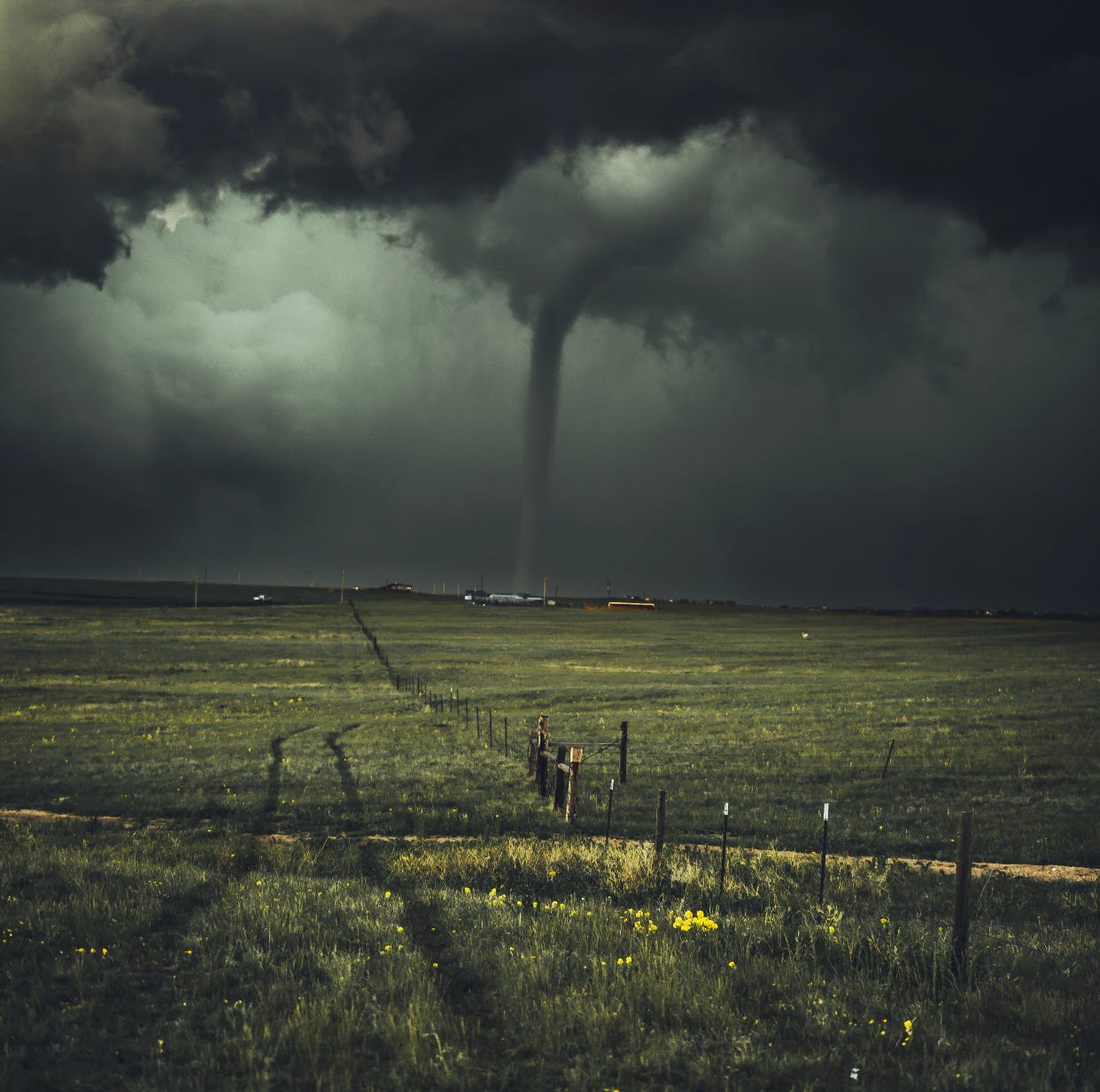
Two days after the hate group left Dayton, I was at home with the local news on in the background. “You need to be in your safe spot,” I heard Chief Meteorologist McCall Vrydaghs say. I was convinced the weather alerts that had popped up on my phone were for more remote cities. Her voice was calm but firm, a seriousness, a tension in her tone:
“Ludlow Falls right now, I’M SERIOUS, get to your safe spot!
You need to be in the lowest interior part of a sturdy structure.
Get there NOW! This is a dangerous situation that’s been ongoing…”
She broke down—on set—and I knew we might be in trouble.
Dayton, a town of about 130,000 people, seems stuck in a time warp. The city is still largely segregated. The east side: predominantly White. The west side: mostly occupied by Blacks, and I’m not sure people of any color (if given a choice) would have it any other way. Hate group: enter here.
The camera switched to Cheryl McHenry—a seasoned veteran and Emmy award-winning anchor—who took the helm until the chief meteorologist regained her composure. I shuffled my daughter into our downstairs bathroom. She hunkered on the floor and I sat on the toilet listening to Ms. Vrydaghs’ voice streaming on social media. My daughter and I said a prayer.
In times of crisis, we should trust someone.
I didn’t run when I realized the fracture between him and his mother nor when he placed a Bible between us that it seemed he had never read. I didn’t run when I noticed he expected me to always be available but was rarely available himself. I wasn’t suspicious when he wanted to know all my friends. Nor was I suspicious that I never knew which of his friends kept reporting to him that they’d seen me somewhere I had not been. I called an old boyfriend—the one my mom liked—for a reprieve, but he had a way of damaging me when he was inside me.
I returned the pearl-handled revolver to the cop and made myself some lemonade.
The tree outside my bedroom window whooshed around, the crackle and boom of lightning and thunder encamped my daughter and me. It had been a long day, a long weekend. I wanted to cry. It was close to midnight when the winds finally settled. My daughter and I slept peacefully in my bed that night. I think she wanted to cry, too.
I got up with the sun around 6:30. We were whole; the tree outside my bedroom window stood erect, swaying gently in the breeze. There was no debris. I turned on the news. We tend to believe our houses, our cars, our bodies are more durable than they actually are. I didn’t leave the house for three days, after consuming all the news stories I could, scrolling picture after devastating picture on Facebook of people I know from church suddenly displaced, stores crushed, cars flipped upside down, houses toppled, restaurants reduced to rubble.
I imagined people wandering aimlessly, in shock. I suppose many wondered where to start, perhaps looking through piles of pictures or calling and whistling for their dog. Puddles, come here boy. Everything’s okay. Puddles? A sob so deep, so necessary unleashed. Is there such a thing as self-preservation? I let it all go.
Three nights prior, I heard the voice of God through McCall Vrydaghs. A warning. Her voice so clear, so passionate, “Get to your safe space! NOW!” If I did not trust God before the Memorial Day Tornadoes, I would have been made a believer. My house, my car, and my body are no match for hatred, tornadoes, or bad boyfriends who smash car windows and faces. This was my lesson: things and people will sometimes crash around me. Sometimes there is a way of escape. Sometimes there is not.
He said he loved me then he pulled my hair. He said he loved me then he tore my clothes off. The accusation, the denial; the beating, the submission. Sometimes I love to hate my city, this country. Is it worth it if your city, your country, makes you feel good and proud to be a part of it then treats you poorly?
I was careful not to flirt or make eye contact with any other male. That thing males do to garner commendations from other males for the showpiece, quietly admiring her from behind, how her hair curls at the ends—the sway of it. Was it worth it for him to lick me? I imagine, even now, the flapping sounds, the clashing of bodies. The sweat: how it gathered then rolled and dripped from one onto the other, mingling and meshing messily, the salt, how we reached for satisfaction, for a release. The gliding ups and downs, the in and out, a rhythm distinctly our own, because I love to hate myself sometimes too.
What a price to pay.
Celina—Hit! Bellbrook—Hit! Harrison Township—Hit! Trotwood—Hit! Communities I drive to and through and am familiar with, even intimately. A person died in Celina. Fifteen tornadoes touched down over one night in and around Dayton, only four short of the yearly average.
You do not know about tomorrow. What is your life? It is like a fog.
You see it and soon it is gone. – James 4:14 (NLV)
He’d take me before I could escape, yanking my ankles and thrusting himself inside the walled-off place. He’d wrap his hand beneath my back, the other beneath my arm, his fingers pressed into my shoulder, ramming, plunging, and I would succumb and push his buttocks so that he would disappear inside me. He was only half-baked. Our hair commingled, his free hand from my back then strangled me. I saw stars. It was daytime, on the couch or on the floor or on the washing machine. He apologized for pulling my hair and wondered why I called the police, why I wanted to disrupt the wet pussy that responded on command on its mission to Venus. He wondered why I couldn’t cope with his bad-boy nature—the violence—and the accusations of flirting or cheating and be okay with a beating—or why I wouldn’t.
When you scoop a bug from your margarita with your fingernail, you know the essence of the bug is still there, but you drink it anyway, hating that margaritas are so good.
I stood inside a government building, I think, asking a Black woman to help me. She made me wait and I watched the door expecting he would come after me. I waited until she folded the slip of paper containing information on where to file a restraining order into my hand. And then, I did, and I talked to a friend secretly at work who convinced me to disappear, and I did that too. I disappeared into the ex-boyfriend’s bed for a while—he had access to weapons and love for me—to sort things out, cry, and go to work. Some of my family members knew about my troubles but steered clear of the mess I had let sit and stiffen because it’s a free country. I took one last call from him to tell him his items were inside grocery bags in the backyard, and I turned in my keys to my first apartment after a year and a half of torment, and because he’d ruined the whole experience. He caused bitterness to grow its roots around my heart valves, but then I ran, and I ran, and I ran to places he could not easily find me, and further and further away, and in the process I cut and dyed my hair and changed my wardrobe, and I changed a little when I detangled the root growing around the valves. I cut them, set them free, and bought a Glock.
Fifteen tornadoes ran their course and wreaked havoc through parts of Dayton and its surrounding areas. The displaced families and businesses may never return; those who could afford a rebuild did, and many are rebuilding still. Hate groups are free to roam and park for a while with a permit. Even a bad boyfriend can sex his girlfriend well, beat her, and run her away. I garnered enough endurance to stay away from him, and I invested in a digitized sign of sorts that reminds me I can always pick up the pieces, rebuild, and leave town because it’s a free country.
I loved the way you wove the pieces together from the storms, the rallies, and the IPV. So powerful and gritty. Really beautiful writing.
Whether natural disasters, cancers of the human heart, or the consequences of our misguided choices, we will all encounter storms. This raw portrayal of some that you have survived attests to your grit, determination, and resilience. I enjoyed this outstanding essay and am eager to read more!